Predictive maintenance for motors, pumps and compressors
Know a machine is going to fail before it stops your line.
Put an EMR Labs sensor on the machine. For the first 24–72 hours of normal running it learns how that machine vibrates, heats up and draws current. After that, it warns you on your phone the moment a reading leaves that range.
- Mount, let it learn, get warned
- 3steps
- To learn what normal looks like
- 24–72h
- To set by hand
- 0thresholds
Pump bearing — vibration over timeExample data
- Learned normal range
- Learning (24–72 h)
- Warning raised
- Critical reached
- Time to plan the repair
What is predictive maintenance?
Predictive maintenance means repairing a machine because its measurements show it is starting to wear, not because it broke or because the calendar says so. Sensors watch vibration, temperature and current. When a reading drifts from normal, you schedule the repair on your terms.
| Reactive | Preventive | Predictive | |
|---|---|---|---|
| When you act | After the machine breaks | On a fixed calendar | When the machine shows wear |
| What triggers the work | A stopped line | A date in the plan | A measured change in the machine |
| The typical cost | Unplanned downtime and emergency call-outs | Parts replaced while still good | A planned stop, on a day you choose |
EMR Labs does predictive maintenance: the machine tells you when it needs attention.
How long does setup take?
EMR Labs setup is three steps, and none of them needs a data specialist. The sensor sets its own alarm limits by watching the machine run. You never type in a threshold.
Mount the sensor
Fix it to the machine housing with magnets or straps. No disassembly, and nothing wired into the machine's controls.
Let it learn — 24–72 h
The sensor records normal running and builds its own normal range for every measurement. After a repair is logged, it re-learns automatically.
Get warned
When a reading leaves its normal range, your phone shows which machine, which measurement and how far it drifted.
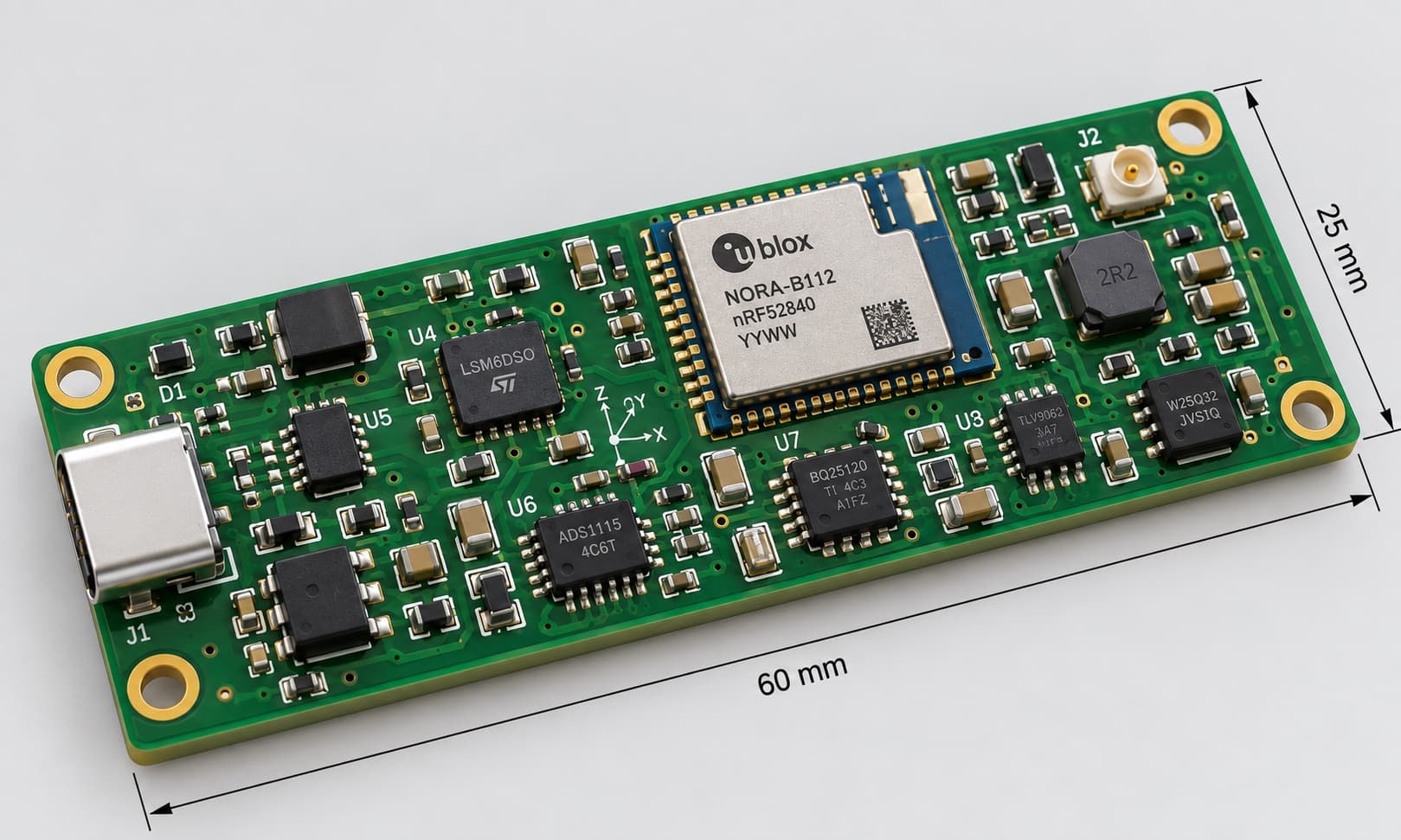
What does the sensor measure?
The EMR Labs sensor reads the four signals that change first when a machine starts to wear. Each one is compared against that machine's own normal, not against a generic chart.
Vibration
3-axis accelerometer
How hard and how fast the machine shakes. Worn bearings, misalignment and imbalance show up here first.
Motors, pumps, fans, spindles
Temperature
NTC / PT100 / PT1000
Surface or oil temperature. A bearing running hot, or a gearbox losing lubrication, raises it.
Motors, bearings, gearboxes
Electrical current
Clamp-on current sensor
A clamp around the power cable: nothing is disconnected. A motor working harder than usual draws more current.
Electric motors, compressors
Pressure
Fluid / air pressure sensor
Leaks, blocked filters and tired pumps change the pressure a system holds.
Hydraulic and pneumatic systems
What do the alerts mean?
EMR Labs uses four alert levels. Each level depends on how far a reading has moved from that machine's normal spread, meaning how much the reading usually varies from minute to minute.
| Level | What the machine is doing | What happens |
|---|---|---|
| Normal | Every reading inside its learned range— | Nothing. Keep working. |
| Warning | One reading drifting slightly1.5–2× normal spread | Notification in the app |
| Attention | A clear drift, or a steady trend2–3× normal spread | Alert with a suggested maintenance task |
| Critical | A severe drift, or a hard limit crossedMore than 3× normal spread | Blocking alert to the operator |
Sensitivity is adjustable in the app. The default flags readings at 3× the normal spread. Lower it to catch changes sooner, at the cost of more alerts.
What do you see in the app?
The EMR Labs app shows one health score per machine, from 0 to 100%, and a list of what changed, when, and on which measurement. No charts to interpret before you know whether to act.
Plant overview · Line 2
6 machines · 1 critical · 1 warning
Pump P-101
94%
Healthy
Compressor C-2
91%
Healthy
Motor M-14
61%
Warning
Fan F-3
97%
Healthy
Conveyor CV-1
88%
Healthy
Spindle S-7
32%
Critical
Spindle S-7
Vibration · last 14 days
| Today 09:42 | Vibration | Critical |
| Tue 14:10 | Vibration | Attention |
| Mon 07:55 | Temperature | Warning |
- Health score from 0 to 100% for each machine and component
- Alert log with time, measurement, level and duration
- Trend charts for vibration, temperature and current
- Maintenance log, exportable to PDF or CSV for ISO audits
Does it need Wi-Fi?
No. EMR Labs works over the plant Wi-Fi, a wired network, its own 4G connection, or no connection at all. Pick the option your IT team is comfortable with.
| Your site | Connection | How it behaves |
|---|---|---|
| Plant with company Wi-Fi | Wi-Fi | Continuous sync, alerts in real time |
| Isolated or remote site | 4G / LTE (built-in SIM) | Periodic sync, alerts by SMS or push |
| Industrial wired network | Ethernet | Connects to your plant control system (SCADA / MES) over MQTT |
| No network at all | Offline mode | Data stored on the device, synced when a connection returns |

Questions maintenance managers ask
Do I need a data scientist to use EMR Labs?
No. The EMR Labs sensor learns the machine's normal behaviour on its own and sets its own limits. Your team reads a health score and an alert, not a model.
Will it work on machines we already have?
Yes, that is what it is built for. The sensor mounts on the outside of the machine with magnets or straps, so lathes, compressors, pumps and conveyors can be monitored without modification.
What if the machine is already worn when the sensor starts learning?
The setup wizard asks you to confirm the machine is in a known good state before learning starts. After a repair is logged, the sensor re-learns from the repaired machine.
Does slow, normal wear trigger false alarms?
No. Slow wear is folded into the normal range gradually. A fast change is not absorbed: it is reported as an alert.
What data leaves the plant?
Only summary measurements and alerts, sent encrypted over HTTPS or MQTT. The raw signal stays on the device and is kept only around an alert. If IT prefers, the 4G option keeps the sensor off the plant network entirely.
For homes
Does it work for home boilers and pumps?
Not yet. A home version of the EMR Labs sensor, for boilers, circulation pumps and appliances, is on the roadmap. Leave your email and we will tell you when it is ready.
Request a demo
Tell us which machines you want to watch. We will show you EMR Labs on a setup like yours. Three fields, nothing more.